
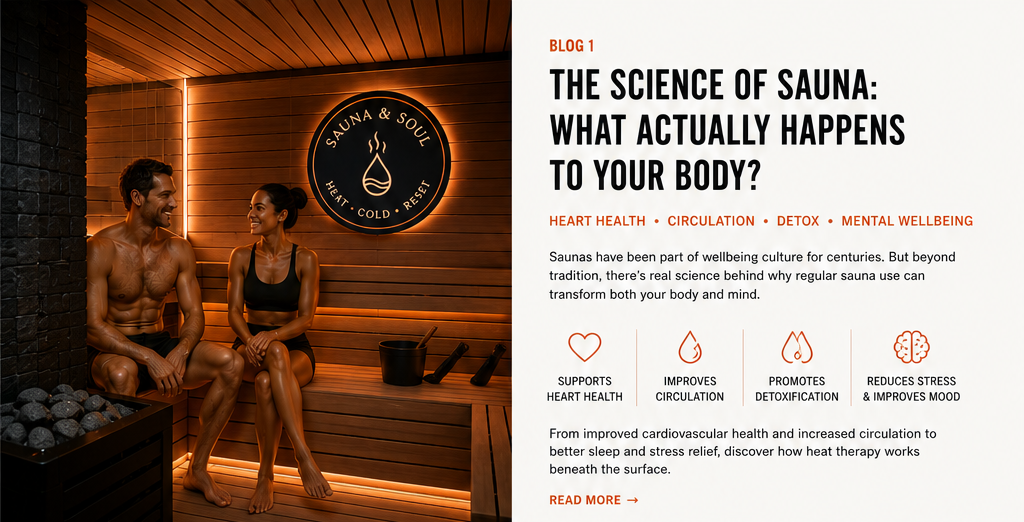
Your body gets to work
When you enter a sauna, your body immediately begins trying to regulate its temperature. Blood vessels near the surface of your skin widen – a process called vasodilation – increasing blood flow to the skin. Your heart begins to beat faster and sweating increases as your body tries to cool itself.
Your heart rate can rise substantially during a sauna session, which is one reason sauna is sometimes compared with light-to-moderate exercise. There is an important distinction, however: sauna complements exercise. It does not replace it. You are not creating the same muscular or metabolic adaptations you would from running, cycling or strength training simply by sitting in a sauna.
What happens to circulation?
Heat causes blood vessels to expand and circulation to increase. It is part of the reason your skin becomes flushed and why your muscles can feel warm and relaxed after several minutes in the sauna.
Researchers have become particularly interested in the potential relationship between regular sauna bathing and cardiovascular health. Some long-term observational studies – particularly from Finland, where sauna use is deeply embedded in everyday life – have found associations between frequent sauna use and lower rates of certain cardiovascular events. That does not prove sauna itself is solely responsible, and lifestyle factors matter, but it has made sauna an increasingly interesting area of scientific research.
Why do you sweat so much?
Your body’s natural air-conditioning system kicks in. Sweat evaporating from the skin and helps your body regulate its rising temperature.
You will occasionally hear this described as ‘detoxing’. We prefer not to make that claim. Your liver and kidneys do the heavy lifting when it comes to removing waste products from your body. The most immediate consequence of sweating heavily in a sauna is much simpler: you are losing fluid. That is why hydration matters, particularly if you have already been exercising.
Why does sauna feel so relaxing?
This might be one of the most valuable parts of the whole experience. Modern life is not particularly good at giving us opportunities to do nothing: phones, emails, meetings, training, children, work and notifications.
Then you walk into a sauna. There is not much to do other than sit. The warmth encourages you to slow down. Your muscles relax. You talk to the person beside you or simply sit quietly. For 10 or 15 minutes, the outside world can wait.
That combination of heat, stillness and human connection is a big part of what makes sauna special. Sauna has also traditionally been social. You do not have to be an elite athlete or understand recovery science. Come in, warm up and switch off.
How long should you stay in?
There is no magic number. For someone new to sauna, a shorter exposure is sensible. Many experienced users enjoy periods around 10-20 minutes, cooling down between rounds.
Your body gets the deciding vote. If you become dizzy, nauseous or uncomfortable, get out. You can always come back in.
And then? You are warm and relaxed, your blood vessels have widened and sitting just outside is a tub of very cold water. Welcome to the other half of Sauna & Soul.
HEAT. COLD. RESET.