The contrast experience
You sit in a hot sauna. Your body warms up. You start sweating. You are relaxed and perfectly comfortable. Then somebody suggests getting into cold water.
It sounds ridiculous. Until you do it.
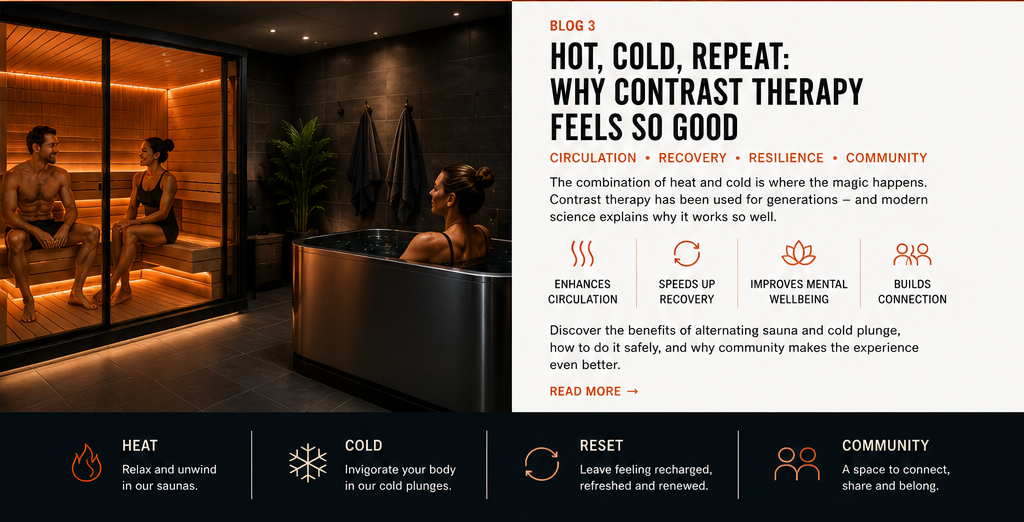
The transition between heat and cold creates one of the most distinctive experiences in modern wellness – although there is actually nothing particularly modern about the ritual. Alternating hot and cold exposure has existed in various bathing cultures for generations. Today you will often hear it called contrast therapy or contrast bathing.
Stage 1: HEAT
Inside the sauna, your body’s cooling mechanisms activate. Blood vessels near the skin widen. Heart rate rises. Sweating increases. Muscles feel warm. Gradually, most people begin to relax.
There is also something psychological happening. You sit down. You stop rushing. You talk. You breathe. You do very little. Then comes the fun part.
Stage 2: COLD
You leave the warmth and enter the plunge. Everything changes. Blood vessels near the skin constrict. Your breathing responds. Your nervous system receives an unmistakable wake-up call.
One moment you are warm and relaxed. The next you are completely focused on the present. There is not much opportunity to think about tomorrow’s meeting while you are sitting in cold water.
Stage 3: RESET
Then you get out. This might be the most enjoyable stage of all. Your body gradually warms again. Your breathing settles. There is often a powerful sense of alertness and achievement.
After recovering for a few minutes? Back into the sauna.
Is contrast therapy scientifically proven?
There is good scientific interest in heat exposure and cold-water immersion individually. There is also research into contrast water therapy for recovery. But evidence for some of the much bigger claims you will encounter online is considerably less certain.
We think it is important to distinguish between the two. You do not need to believe alternating hot and cold water will transform every biological system in your body to enjoy it. There are established physiological responses to heat. There are established physiological responses to cold. Alternating between two dramatically different sensations creates an experience that many people simply find fantastic. Sometimes that is enough.
There’s another ingredient people forget
Other people.
Recovery has become increasingly technical: wearable devices, heart-rate variability, sleep scores, readiness scores, training loads and recovery percentages. All of that data can be useful.
But human beings were sitting together in hot rooms thousands of years before anyone owned a Garmin. Sauna culture has traditionally been communal. People sit together. They talk. They cool down. They go back in. That is something we want to preserve.
Why we built Sauna & Soul
We wanted to create somewhere that sits between fitness, recovery and community.
Some people will come after a run. Some after padel. Some after the gym. Some because they have had a long day at work. And some will come because their friend persuaded them to try a cold plunge and they now inexplicably love it.
You do not need to arrive with a recovery protocol. A session can be incredibly simple:
SAUNA -> COOL DOWN -> PLUNGE -> RECOVER -> REPEAT
Spend longer in the sauna if you like. Spend less time in the plunge. Sit out a round. Talk to someone. Listen to your body. This is not competitive recovery.
We want Sauna & Soul to be somewhere you can spend an hour without your phone. Somewhere you can meet people. Somewhere you can recover from training – or from life. And somewhere you walk out feeling better than when you walked in.
HEAT. COLD. RESET.
Welcome to Sauna & Soul.